BlockCap: Blockchain-Based Capability Authorization for IoT
A blockchain-backed capability-based authorization system for enforcing fine-grained, auditable access control in resource-constrained IoT environments.
BlockCap is a capability-based authorization system designed to enforce fine-grained, auditable access control in resource-constrained IoT infrastructures. The system addresses the limitations of centralized identity- and role-based access control in IoT by combining capability tokens with blockchain-backed governance and traceability.
Rather than assuming that IoT endpoints can participate in consensus or store global policy state, BlockCap introduces a role-separated trust model in which authorization decisions are locally enforced while globally governed through smart contracts. The design explicitly targets heterogeneous deployments spanning cloud, fog, edge gateways, and constrained sensors/actuators.
System Model and Trust Assumptions
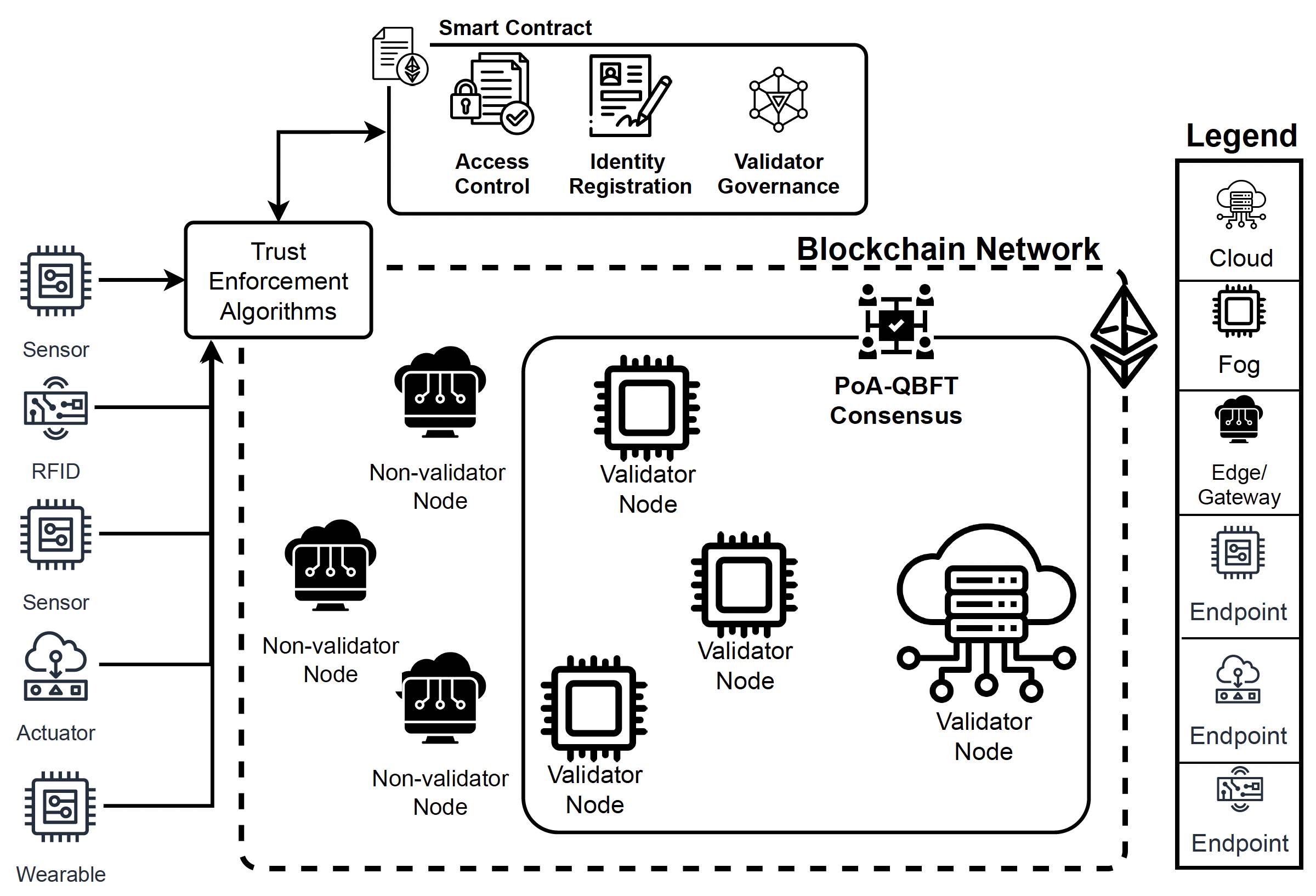
BlockCap system model showing validators, non-validator gateways, and constrained endpoints. Blockchain participation is restricted to capable nodes, while enforcement occurs at the service boundary.
BlockCap defines a network of nodes \(N = \{n_1, \dots, n_k\}\), each assigned a role:
- Validators (cloud/fog): maintain blockchain state, execute consensus, and approve policy-critical operations.
- Non-validator gateways (edge/fog): enforce access decisions and query on-chain capability state.
- Endpoints (sensors/actuators): expose services but remain blockchain-agnostic.
Capability-Based Authorization Model
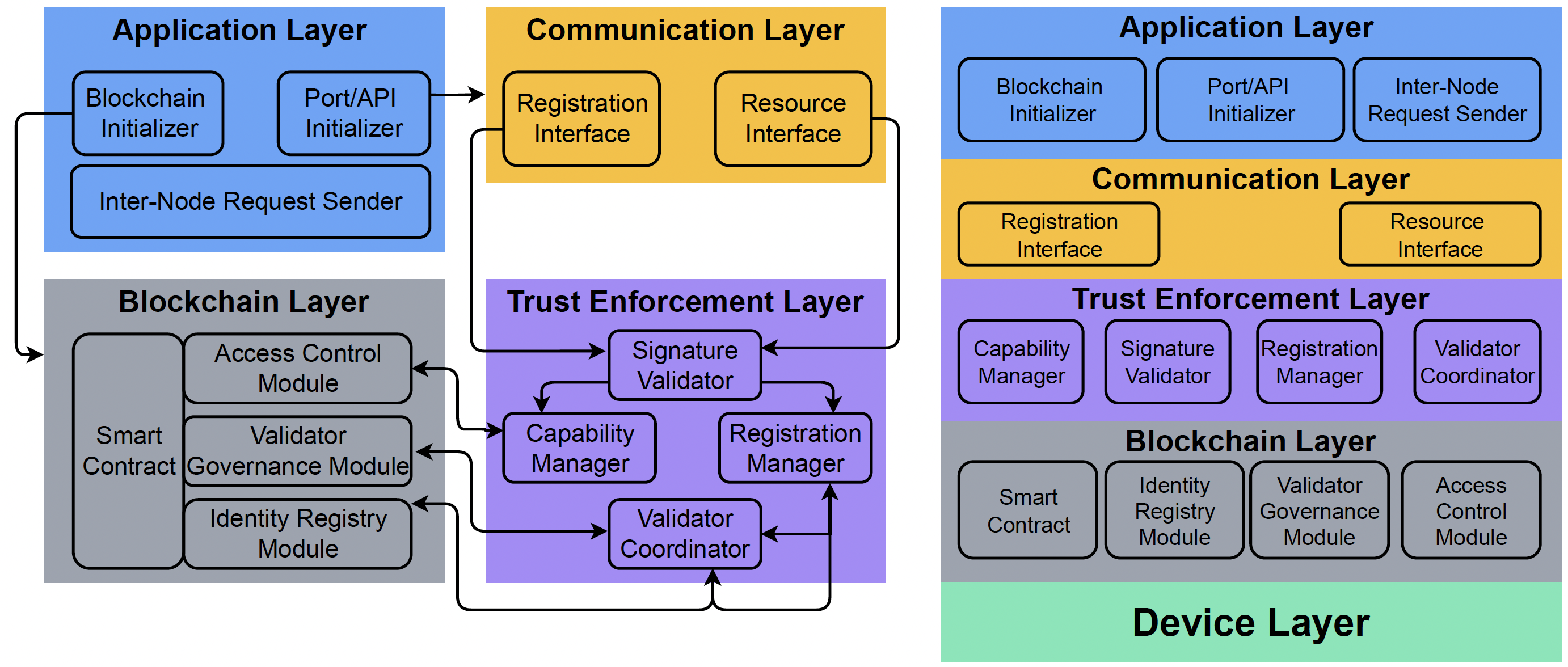
Directed graph representation of BlockCap’s trust model. Capabilities are defined as subject → object → operation tuples and enforced at API boundaries.
BlockCap encodes authorization as capability tokens that specify:
- Subject node identity
- Target node and service
- Permitted operations (READ, WRITE, EXECUTE, TRANSMIT)
- Issuance time, validity window, and revocation state
- Issued and revoked on-chain via smart contracts
- Checked off-chain by gateways before request forwarding
- Auditable through immutable blockchain logs
Governance and Consensus
BlockCap is implemented on Hyperledger Besu using a Proof-of-Authority (PoA) network with QBFT for validator consensus. Governance-sensitive actions—such as node registration, validator admission, and capability issuance—are coordinated through smart contracts and validator voting.
This approach ensures:
- Low-latency block finality
- Resistance to single-point-of-failure
- Deterministic authorization state across validators
Security Analysis
The system is analyzed using the STRIDE threat model, covering:
- Spoofing of node identities
- Tampering with authorization state
- Repudiation of access decisions
- Information disclosure
- Denial-of-service
- Elevation of privilege
Experimental Evaluation
BlockCap is evaluated on a heterogeneous testbed comprising:
- Cloud and fog nodes (validator-capable)
- Edge gateways (non-validator enforcers)
- Resource-constrained IoT endpoints
- Capability issuance and validation latency
- CPU and memory overhead on gateways
- RPC performance under concurrent requests
- Blockchain synchronization and throughput
Key Contributions
- Blockchain-backed capability authorization tailored for IoT constraints
- Decoupled enforcement and governance via role separation
- Fine-grained, bidirectional access control
- Formal STRIDE-based security analysis
- Practical deployment and evaluation on real hardware