ARM-Based Benchmarking of Lightweight Cryptographic Ciphers for IoT
Unified benchmarking framework for evaluating lightweight block and stream ciphers on ARM IoT devices with performance, energy, and resource metrics.
This project implements a comprehensive benchmarking framework for evaluating the software performance of Lightweight Cryptographic Ciphers (LWCCs) — both block and stream — on constrained IoT-class ARM processors. The work is documented across two publications — in MDPI Future Internet and Springer SciSec — which share the same experimental methodology and platform but explore complementary analysis and presentation. The project addresses a critical IoT security challenge: how to choose cryptographic primitives that balance security strength with minimal performance and energy overhead in devices with limited CPU, RAM, and power budgets.
Objectives
- Develop a flexible and lightweight benchmarking tool that supports both block and stream cipher implementations.
- Measure multiple performance metrics: throughput, cycles per byte (CpB), memory footprint, ROM usage, and energy consumption.
- Introduce the E-Rank metric — a combined measure of efficiency that integrates performance, memory, and energy.
- Identify optimal cipher choices for different IoT deployment scenarios.
Methodology
- Hardware: Raspberry Pi Zero W with single-core ARM1176JZF-S CPU (512 MB RAM).
- Energy Measurement: Arduino UNO + INA219 power sensor to isolate cipher execution power usage from background processes.
- Software:
- Core cryptographic operations implemented in C for speed.
- Orchestration, measurement, and data logging in Python using
ctypesto interface with compiled cipher code.
- Cipher Set:
- Lightweight Block Ciphers: PRESENT, XTEA, CLEFIA, SIMON, SPECK, AES (baseline).
- Lightweight Stream Ciphers: Grain-v1, Grain-128a (optimized), Trivium, Mickey, Salsa, Sosemanuk.
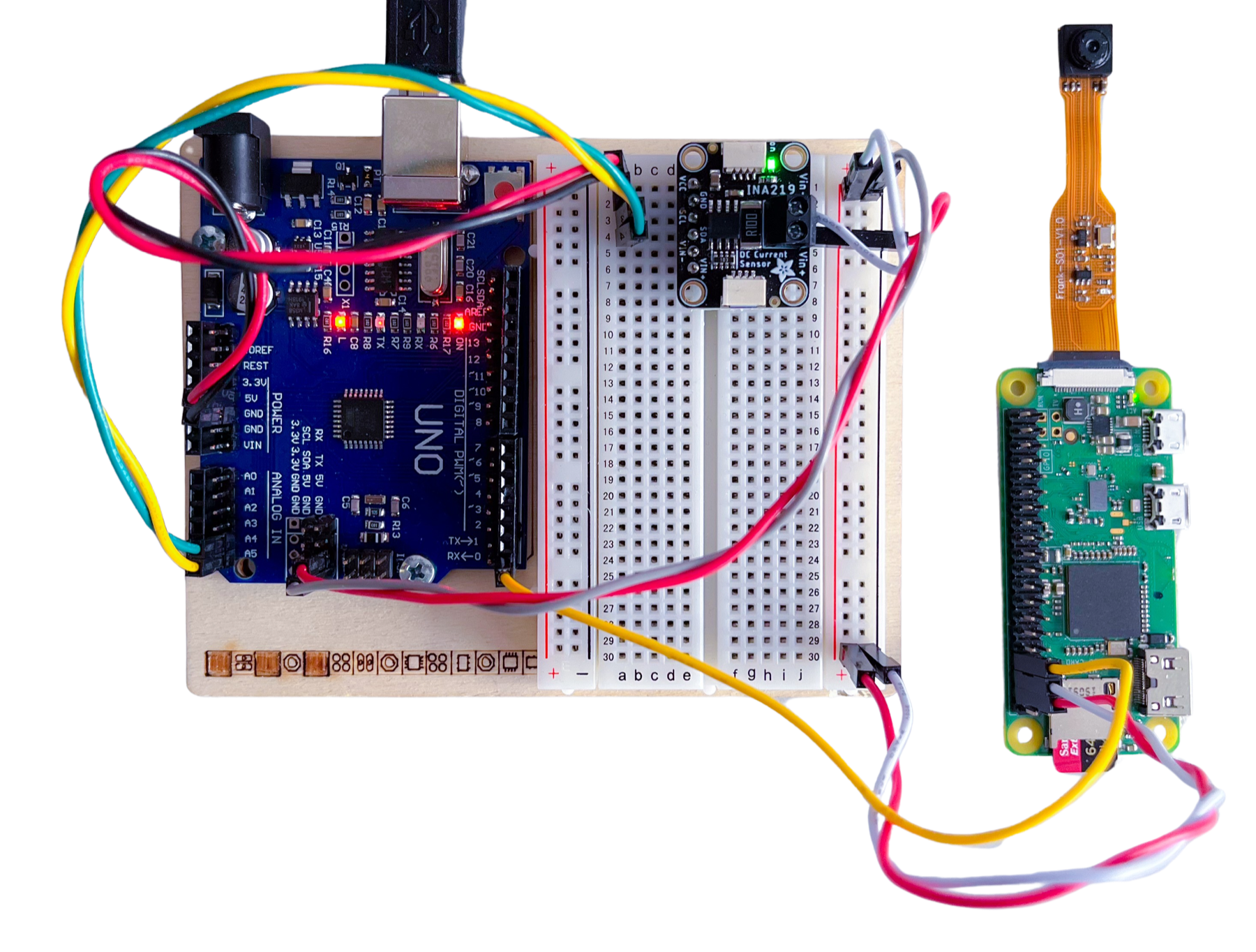
Custom benchmarking setup with GPIO-triggered power measurement to ensure precise per-cipher energy readings.
Evaluation Metrics
- Throughput (Kbps) – Speed of encryption/decryption.
- Cycles per Byte (CpB) – CPU cycles required per byte processed.
- Memory Footprint (bytes) – RAM usage during cipher execution.
- ROM Usage (bytes) – Flash storage space used by cipher code.
- Energy Consumption (µJ/B) – Energy required per byte processed.
- E-Rank – Unified performance metric:
E-Rank = Throughput / ((ROM + 2 × RAM) × Energy)
Key Findings
- Best LWBC (Block Cipher): XTEA – Highest throughput, lowest CpB, lowest energy, but highest RAM usage.
- Best LWSC (Stream Cipher): Salsa – Highest E-Rank due to exceptional throughput and efficient resource use.
- Trade-offs:
- Hardware-oriented ciphers (e.g., SIMON, PRESENT) show lower software performance but smaller code size.
- Software-optimized ciphers (e.g., SPECK, Salsa) excel in throughput but may require more memory.
<!--
  See https://www.debugbear.com/blog/responsive-images#w-descriptors-and-the-sizes-attribute and
  https://developer.mozilla.org/en-US/docs/Learn/HTML/Multimedia_and_embedding/Responsive_images for info on defining 'sizes' for responsive images
-->

<img
  src="/assets/img/projects/lwcc-results.jpg"

    class="img-fluid rounded z-depth-1"


    width="100%"


    height="auto"


    title="Performance and E-Rank comparison"


    loading="lazy"

  onerror="this.onerror=null; $('.responsive-img-srcset').remove();"
>
</picture>
</figure>
Performance comparison showing throughput, CpB, energy, and E-Rank for all evaluated block and stream ciphers.
–>
Impact & Applications
- IoT Security Design: Offers a decision-making framework for selecting ciphers based on device constraints.
- Benchmarking Methodology: Can be reused for future cipher candidates or different microcontroller platforms.
- Academic Contribution: Demonstrates how multi-metric evaluation changes cipher rankings compared to throughput-only analysis.
Publications
- M. Khan, D. Johansen, H. Dagenborg, Performance Evaluation of Lightweight Cryptographic Ciphers on ARM Processor for IoT Deployments, SciSec 2024 (LNCS 15441).
- M. Khan et al., Comprehensive Benchmarking of Lightweight Cryptographic Primitives for IoT Devices, Future Internet, MDPI, 2025.