CAV- and VANET-Enabled Traffic Congestion Reduction and Accident Circumvention
Integrating Connected Autonomous Vehicles and VANETs for safe-distance maintenance, overtaking, and lane-shifting to reduce congestion and accidents.
4. Simulation Snapshots
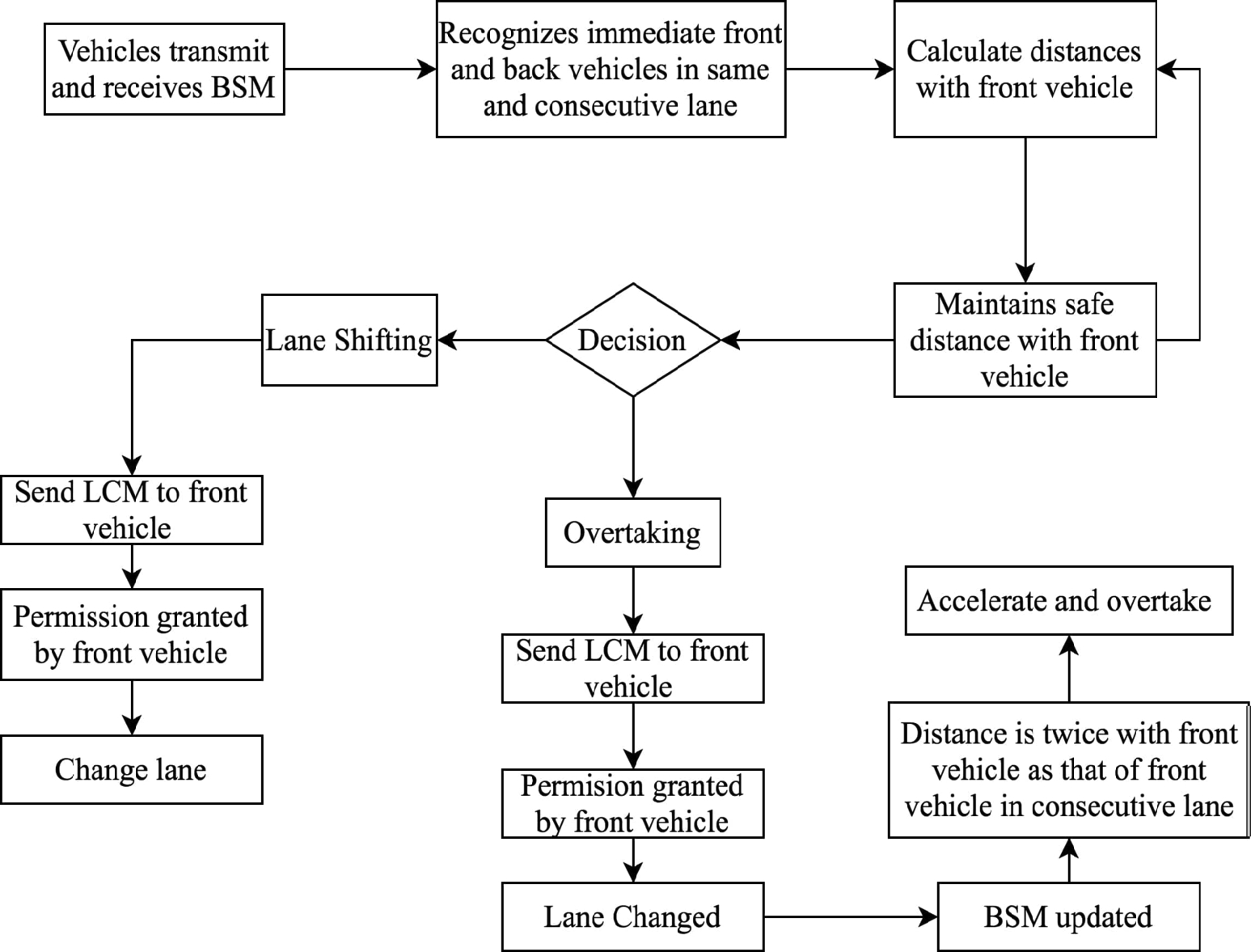
Flowchart showing safe-distance enforcement, overtaking logic, and lane-switching decisions under varying traffic and accident conditions.
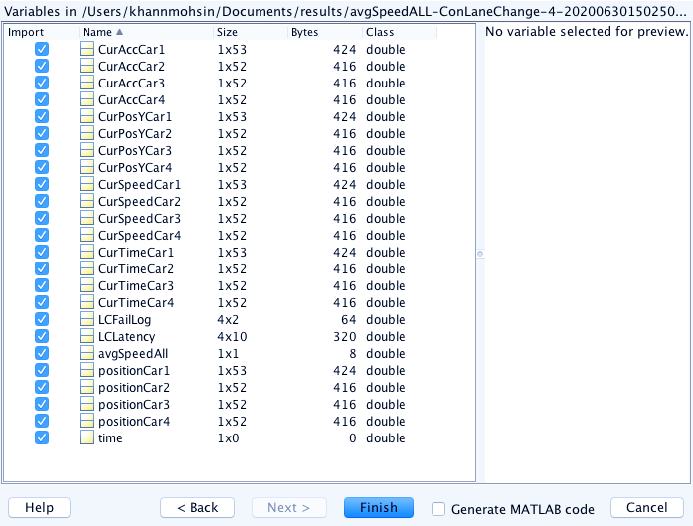
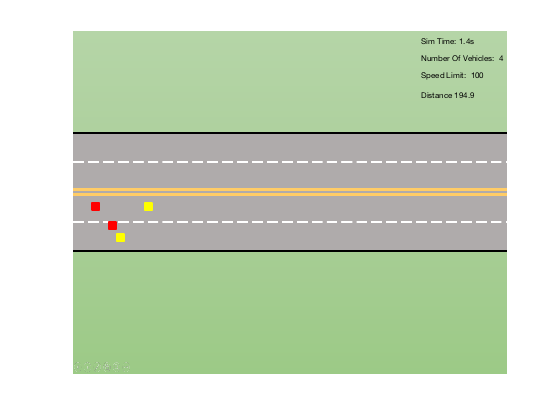
Left: GUI panel for configuring speed, acceleration, and lane position of four different vehicles. Right: MATLAB simulation showing live roadway model applying CAV and VANET-based congestion and accident avoidance rules.
1. Motivation
- Traffic jams — both recurring (bottlenecks) and non-recurring (accidents, weather) — cause economic and safety impacts worldwide. - "Phantom jams" emerge when drivers brake abruptly due to unsafe spacing, propagating backward as congestion waves. - Many developing countries rely on Level 2 automation, where drivers control the vehicle but can benefit from assisted decision-making. - This work integrates IoT-based real-time inter-vehicle communication to reduce accident risks from overtaking and lane changes, while smoothing traffic flow.
2. Methodology
Technologies & Platforms: - CAV + VANET Communication for local vicinity data sharing (speed, location, distance). - MATLAB Driving Scenario Toolbox for simulation and algorithm validation. - Google Maps API for realistic roadway mapping in test cases. - IoT Hardware (proposed): Raspberry Pi integration for real-world deployment. **Core Algorithms:** 1. **Safe Distance Maintenance** – Continuous monitoring and adjustment to avoid phantom jams. 2. **Controlled Overtaking** – Decision-making based on available space and traffic in adjacent lanes. 3. **Lane Shift Protocol** – Permission-based lane change execution to minimize disruptions. **Performance Testing:** - Simulated with increasing complexity of road layouts. - Evaluated on response time, congestion reduction, and safety event prevention.
3. System Architecture

Vehicles exchange local telemetry via VANET; MATLAB algorithms process inputs to issue cooperative maneuver permissions.
Left: Simulated roadway applying safe-distance, overtaking, and lane-shift rules. Right: Decision flow for overtaking in multi-lane traffic.
5. Key Results
- **Reduced Congestion:** Significant decrease in stop-and-go waves during simulations. - **Improved Safety:** Lower frequency of simulated collisions in overtaking/lane shift scenarios. - **Scalability:** Framework adaptable to varying road types and traffic densities.
6. Applications
- Smart transportation systems in urban and highway environments. - Augmentation of Level 2 automation in developing countries. - Integration into intelligent traffic management centers for real-time control.
7. Publications
- Khan, M., & Arora, B. (2021). Traffic Jam Minimization and Accident Avoidance System Using IoT. In *Evolving Technologies for Computing, Communication and Smart World* (Springer). - Khan, M., & Arora, B. (2021). Traffic Congestion Reduction and Accident Circumvention System via Incorporation of CAV and VANET. In *Lecture Notes in Networks and Systems* (Springer).