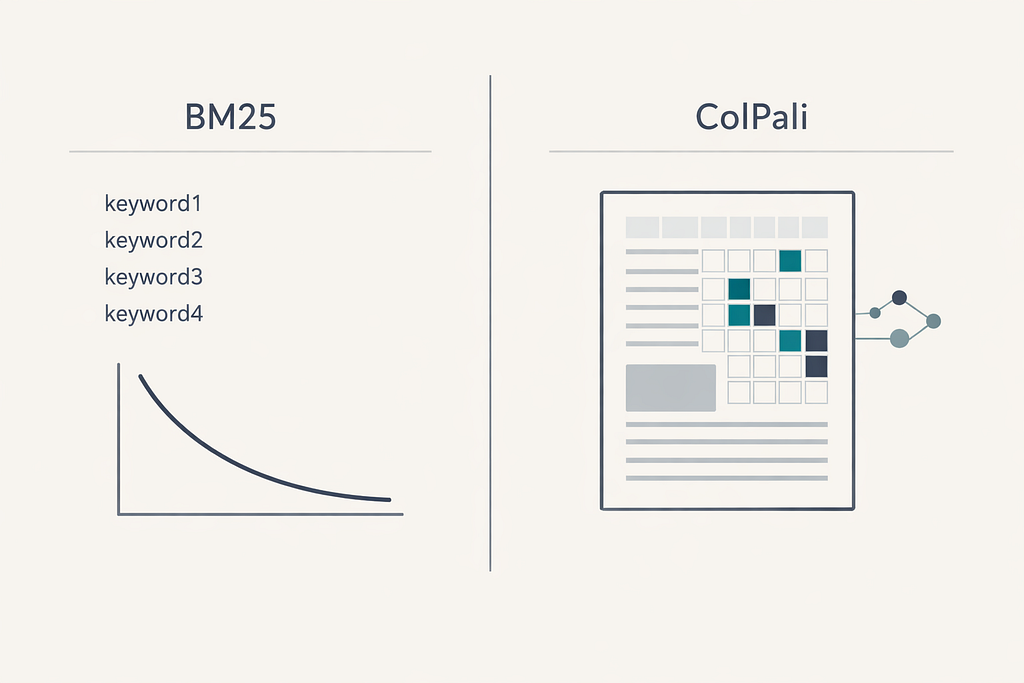
BM25 is engineered for lexical certainty. ColPali is engineered for visual-semantic understanding. Your choice changes not just relevance — but the entire risk surface.
If your search system only needs to find a paragraph with a specific keyword, BM25 is boring — and reliably correct.
If your system needs to find a number buried inside a scanned table on page 47 of a PDF, BM25 can be confidently wrong.
ColPali exists in that gap.
It treats a document page as an image, embeds it using a vision-language model, and performs late interaction scoring at patch-level granularity. That means it “sees” layout, tables, figures, and structure — not just tokens.
The real question isn’t which is smarter. It’s which failure mode you can afford.
Search is no longer just search.
It is:
If retrieval is wrong, the LLM doesn’t simply fail. It produces confident, authoritative answers based on incomplete or irrelevant context.
That is operationally expensive.
Two structural shifts make this comparison critical:
Choosing between BM25 and ColPali is no longer an ML taste preference. It is an architectural decision.
BM25 is a probabilistic ranking function built on:
It rewards exact term matches and penalizes verbosity. It is mathematically interpretable. It is tunable.
If a document ranked highly, you can explain why:
“It contained these terms with these weights.”
BM25 assumes text is clean and tokenizable. Modern enterprise documents rarely are.
ColPali represents a different philosophy.
Instead of extracting text first, it:
This means:
It retrieves meaning embedded in structure.
With BM25, ranking is legible. With ColPali, ranking is distributed across vector interactions. That shifts governance complexity.
Most benchmarks compare:
Those matter. But in production systems, the decisive variable is often:
Governance ergonomics.
BM25 is easier to justify under audit.
ColPali is better at retrieving from messy, real-world documents.
But when something goes wrong:
In highly regulated industries, that question outweighs marginal recall improvements.
BM25 is not obsolete.
ColPali is not universally superior.
In many production systems, the real architecture is hybrid:
The winning strategy is rarely ideological. It is layered.
If your documents are mostly structured text and identifiers, BM25 remains powerful, stable, and defensible.
If your documents are layout-heavy, visually complex, or OCR-fragile, ColPali changes what retrieval can see.
But the deeper difference is this:
BM25 optimizes for clarity and interpretability. ColPali optimizes for realism and semantic coverage.
Your decision determines not just relevance quality, but the operational complexity of your system. And in production AI systems, complexity is rarely free.